


Learning objectives
- Distinguish interest, purchase intent and completed delivery.
- Design a pilot with a customer, scope and learning objective.
- Use explicit readiness and stop-or-adjust criteria before scaling.
Name one customer and a concrete problem
Describe who experiences the problem, when it occurs and what they do today. Market analysis should include substitutes, including doing the work internally or tolerating the problem. Ask about actual recent behavior before presenting your solution. Compliments can show politeness; a request with a real budget, deadline and decision process is stronger evidence, though it is still not a completed sale.
Choose the smallest useful launch test
A pilot needs a specific uncertainty to resolve: willingness to pay, delivery time, onboarding effort or repeat use. State what is included and excluded, the number of customers and the period. Define what you will observe and how permission and customer expectations will be handled. An unfinished product offered without clear boundaries is not automatically a meaningful experiment.
Connect the offer to delivery and cash
Map the work from enquiry to payment, including staff time, suppliers, support and rework. Estimate the variable cost of one delivered order separately from fixed running costs. Financial planning should reflect when payments arrive and bills fall due. Check the relevant registration, permission and contractual questions with the appropriate authority or professional before offering the actual activity.
Decide what evidence permits the next step
Set review criteria before launching so enthusiasm does not quietly change the rules afterward. Include customer outcomes and delivery quality, not only visits or followers. Specify what would justify continuation, adjustment or stopping. Keep the sample size and limitations visible. A good small pilot supports a better next decision; it does not prove that the same results will hold at a larger scale.
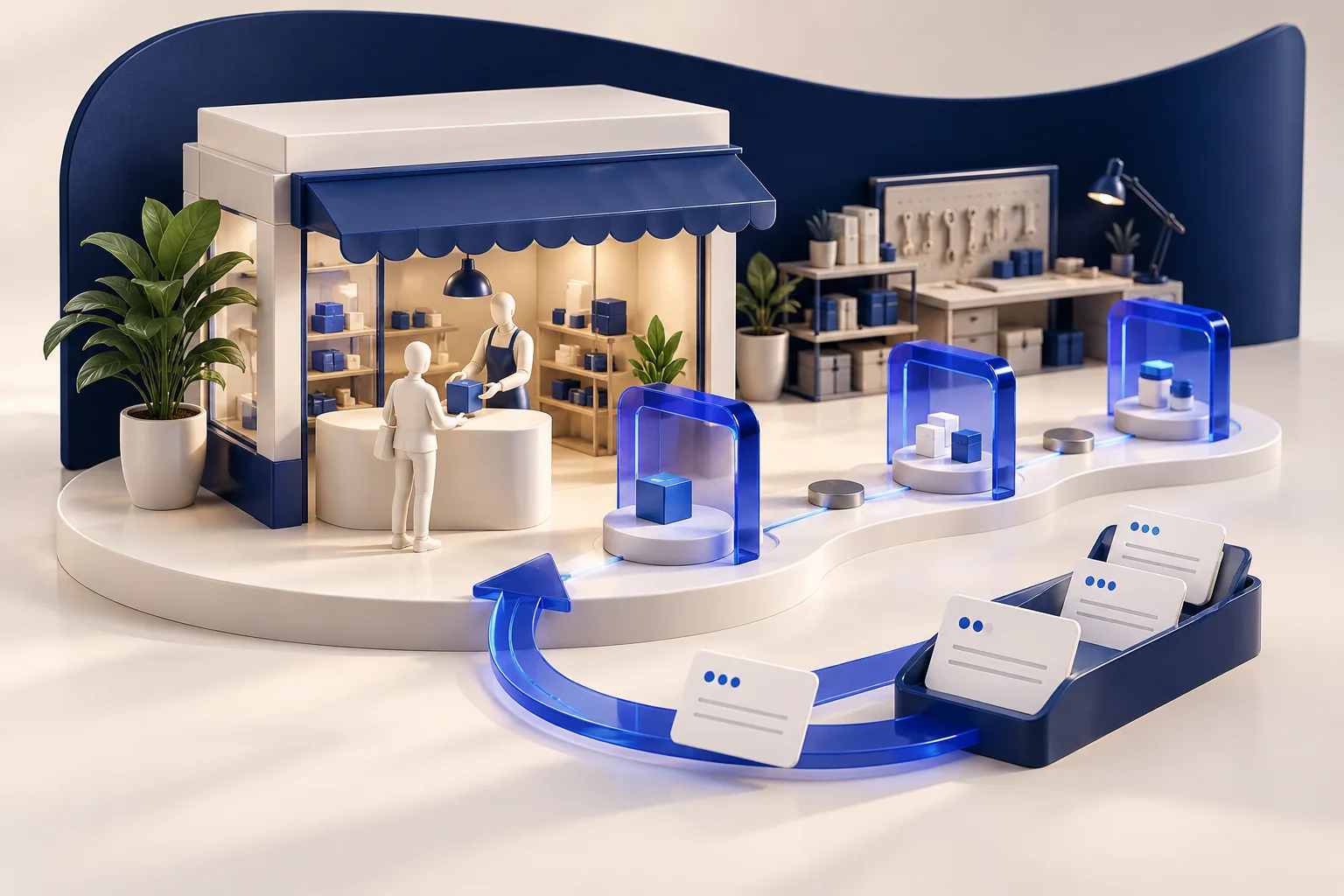
A learning loop for a launch
Each cycle ends with a decision about the next bounded commitment.
State
Write the customer problem and the assumption that matters most now.
Test
Offer a limited, transparent experiment that can produce relevant evidence.
Observe
Record customer behavior, delivery effort, cash timing and unexpected problems.
Decide
Continue, change the offer or stop, using criteria agreed before the test.
Comparison
| Signal | What it may suggest | What remains unproven |
|---|---|---|
| Positive interview response | The problem or proposal attracts attention | Payment and repeated use |
| Paid limited pilot | Some customers will transact under defined conditions | Reliable delivery at scale |
| Successful completed orders | The current team can deliver in the tested setting | Demand and capacity in other segments |
Hypothetical example: appointment reminder service
An imagined team wants to offer appointment reminders to small clinics. Instead of selling a broad automation package, it selects one clinic and a limited reminder workflow.
- Agree the permitted data, staff responsibilities and a short trial period before any patient information is used.
- Record reminder delivery, staff time and exceptions, alongside the clinic’s actual willingness to continue paying.
- Review whether the workflow solves the stated problem at an affordable delivery cost before adding more clinics or features.
The team learns about one workflow in one setting. The pilot is not evidence that every clinic will buy, that every message will arrive or that all privacy requirements have been resolved.
Practical checklist
- Define one customer group and the current alternative.
- Name the uncertainty the pilot should reduce.
- Set scope, permission, budget and delivery responsibilities.
- Agree continuation, adjustment and stop criteria in advance.
Common pitfalls
Launching many features to avoid choosing
A broad offer creates more dependencies and makes it harder to learn why customers do or do not buy.
Counting attention as proof of a business
Views and followers may help reach people, but they do not establish payment, delivery quality or sustainable operating economics.
Questions and answers
Must a launch begin with a fully automated product?
No. A transparent, limited manual service can sometimes test the customer problem first. It still needs realistic delivery boundaries, appropriate permissions and honest expectations.
When should a pilot be expanded?
When relevant evidence and operational readiness justify a defined next step. There is no universal number of customers or duration that makes expansion safe or commercially successful.
Sources and further reading
- MIT Sloan: disciplined entrepreneurshipMIT Sloan School of Management
A primary educational reference for focusing on customers and testing a venture’s assumptions; no institutional affiliation is implied.
- SBA: launch your businessU.S. Small Business Administration
Official launch-planning orientation; jurisdiction-specific registration requirements need separate local verification.